FINAL CLASS ASSIGNMENT
Questions.
Michael Robinson wrote:
1) In his “Critical Reflections” article for Artforum, Boris Groys writes that artists “protect themselves against theoretical commentary in the hopes that a naked work of art will be more seductive than one dressed in a text.” How do people feel about this assertion? I would argue that I see a lot of artists striving to do the opposite: protect their work with grounding in specific texts. Agree/disagree?
In order to answer my distinguished colleague’s excellent question I will use two examples within contemporary art. First I will explain how the work of Matthew Ritchie is an example of an artist attempting to add critical weight to his work by grounding it in text. Second I will point out how the popularity of what is often dismissed as “idiosyncratic personal narratives” in work is the result of a large group of artists reacting against their MFA educations that promote that type of grounding.
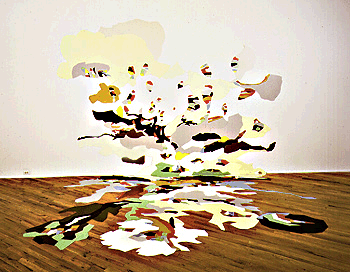
Matthew Ritchie creates paintings, sculptures and installations whose patterns and structures are based on M theory. M theory you ask? That sounds smart. Oh it is, two letters smarter the K theory. According to Wikipedia, “M-theory (sometimes also called U-theory and occasionally MU-theory) is a theory of physics, which is believed to incorporate and generalize the various superstring theories.” Don’t ask me to explain it, but don’t ask Ritchie either. Ritchie Admits gaining most of his fundamental knowledge of string theory from abandoned textbooks that he found in the apartment building he used to manage in Brooklyn. However a few random textbooks are enough to discover a hand full of cool looking diagrams or illustrations of fractals. Taking these images and throwing in some good ol’ mythology and chance Ritchie makes intricately laced work that seems to percolate with knowledge and gravitas, or in this case stringytas. But really the work is nothing more than an extremely elaborate variation on those diagrams and illustrations that caught his eye in Brooklyn. That is not to say they aren’t beautiful. Beyond being beautiful the connection to quantum physics that his work purports to have helps to remove it from pure aesthetics. It adds a weight to him and his work that helps to separate him from other artists. “ Mathew Ritchie? Oh yeah he’s one of those smart artists not just some hack who’s good at mixing warm and cool colors. I mean his work is really about something”. But is it? And why should it matter if Ritchie only uses his Jedi Quantum powers to come up with imagery?
The increasing herds of artists being corralled through our country’s various MFA programs are taken as a sign of the professionalisation of the artist. Often this professionalisation is talked about in terms of art students adapting their practices in order to be successful within the commercial market. It is however also causing artists to adapt to the academic market. As there are more and more willing MFA students there are more universities willing to educate, and in many cases profit from them. But as these universities expand their arts programs they also expect that those programs adapt themselves to the existing academic framework of the university. Studio work becomes research, and your artwork becomes your thesis. Discussions morph into “panel” discussions. Let’s be honest research on why red looks good next to green does not really fly. And a thesis on why texture is cool does not really catch a dean’s eye. So artists begin to figure out how their work could be discussed in this new environment. Some of them find that their work does fit quite well, others are able to develop an academic language in which to talk about their work, while some may just throw on the coat of a given idea or approach in order to navigate the system. This academic professionalisation is not only occurring within the universities but with most grant-giving organizations. With increasingly less governmental support for the arts the few remaining granting bodies have to choose from a larger artistic population. How should they decide? How can you choose the best from so many diverse artists? “Well hey look at this, this guy makes junk about String theory. That sounds worthwhile.” Like I mentioned earlier some artists do make work that actually deals with ideas and theories that are at home within the academic arena however many artists like Ritchie just find a way to package their work that way.
On the other side of the spectrum are artists like Claire Rojas or Amy Cutler who are making extremely pretty work that claims to offer nothing more than personal narrative. These artists like so many others currently working seem to be making work that directly opposes academic professionalisation. The growth in quasi naive art making is understandable. It is painful to hear artists struggle to place their work in academically valid contexts. It is even more painful to try and do it yourself. Watercolors of women with pianos strapped to their backs or plaid shirted men hunting tigers are on the other hand not painful to look at. The narrative elements seem to suggest some grander purpose than pure decoration, but one that can’t really be known or understood so it doesn’t really have to be explained or worried about. These artists just use the narrative as a frame work for image making, just as Ritchie uses the universe as a structure for image making.
In the end I agree with Jonathon when he explains that there are artists who use text as a crutch and those who use nakedness as a crutch. (A naked crutch?) But what is the third way? On her blog Selina Trepp, to refer to yet another classmate, talks about the importance of balancing concept with intuition in the making of work. I agree completely. The best work I see is not immediately explainable or weighted down by a specific theory or idea, nor is it simplistic and pointless. The kicker is that it is difficult to get to that space, and in the process of trying to reach that ideal of art making an artist can expect to make work that could fall into either category.
posted by Justin at 2:30 PM


0 Comments:
Post a Comment
<< Home